河南师范大学附属中学2025-2026学年高三上学期9月开学考试英语试题(无听力)(共5页)

河南师范大学附属中学2025 2026学年高三上学期9月开学考试英语试题 1

本次为大家整理的是河南师范大学附属中学2025-2026学年高三上学期9月开学考试英语试题(共5页),高清完整版PDF下载。这套试卷贴合2025届新高考英语命题方向,覆盖高中英语核心考点,适合高三同学一轮复习刷题自测、查漏补缺,也可供高中英语老师作为复习备课资料使用。
试题预览:

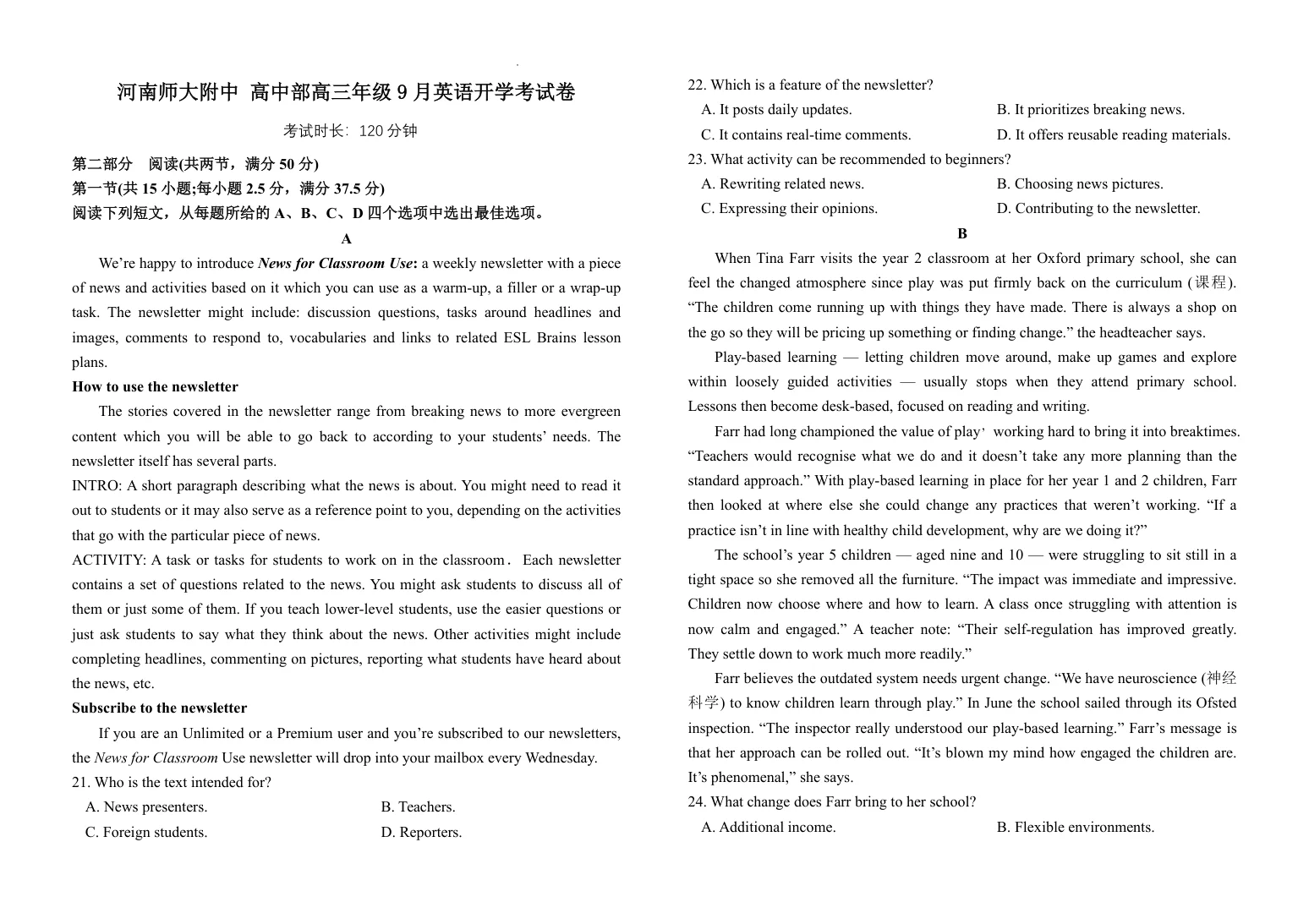
第一节(共 15 小题;每小题 2.5 分,满分 37.5 分)

阅读下列短文,从每题所给的 A、B、C、D 四个选项中选出最佳选项。

A

We’re happy to introduce News for Classroom Use: a weekly newsletter with a piece of news and activities based on it which you can use as a warm-up, a filler or a wrap-up task. The newsletter might include: discussion questions, tasks around headlines and images, comments to respond to, vocabularies and links to related ESL Brains lesson plans.
How to use the newsletter

The stories covered in the newsletter range from breaking news to more evergreen content which you will be able to go back to according to your students’ needs. The newsletter itself has several parts.

  • INTRO: A short paragraph describing what the news is about. You might need to read it out to students or it may also serve as a reference point to you, depending on the activities that go with the particular piece of news.
  • ACTIVITY: A task or tasks for students to work on in the classroom. Each newsletter contains a set of questions related to the news. You might ask students to discuss all of them or just some of them. If you teach lower-level students, use the easier questions or just ask students to say what they think about the news. Other activities might include completing headlines, commenting on pictures, reporting what students have heard about the news, etc.
Subscribe to the newsletter

If you are an Unlimited or Premium user and you’re subscribed to our newsletters, the News for Classroom Use newsletter will drop into your mailbox every Wednesday.

  1. Who is the text intended for?

    A. News presenters.

    B. Teachers.

    C. Foreign students.

    D. Reporters.

  2. Which is a feature of the newsletter?

    A. It posts daily updates.

    B. It prioritizes breaking news.

    C. It contains real-time comments.

    D. It offers reusable reading materials.

  3. What activity can be recommended to beginners?

    A. Rewriting related news.

    B. Choosing news pictures.

    C. Expressing their opinions.

    D. Contributing to the newsletter.

B

When Tina Farr visits the year 2 classroom at her Oxford primary school, she can feel the changed atmosphere since play was put firmly back on the curriculum (课程). “The children come running up with things they have made. There is always a shop on the go so they will be pricing up something or finding change,” the headteacher says.
Play-based learning — letting children move around, make up games and explore within loosely guided activities — usually stops when they attend primary school. Lessons then become desk-based, focused on reading and writing.
Farr had long championed the value of play, working hard to bring it into breaktimes. “Teachers would recognise what we do and it doesn’t take any more planning than the standard approach.” With play-based learning in place for her year 1 and 2 children, Farr then looked at where else she could change any practices that weren’t working. “If a practice isn’t in line with healthy child development, why are we doing it?”
The school’s year 5 children — aged nine and 10 — were struggling to sit still in a tight space so she removed all the furniture. “The impact was immediate and impressive. Children now choose where and how to learn. A class once struggling with attention is now calm and engaged.” A teacher note: “Their self-regulation has improved greatly. They settle down to work much more readily.”
Farr believes the outdated system needs urgent change. “We have neuroscience (神经科学) to know children learn through play.” In June the school sailed through its Ofsted inspection. “The inspector really understood our play-based learning.” Farr’s message is that her approach can be rolled out. “It’s blown my mind how engaged the children are. It’s phenomenal,” she says.
  1. What change does Farr bring to her school?

    A. Additional income.

    B. Flexible environments.

    C. Upgraded equipment.

    D. Diverse outdoor games.

  2. What is the main reason for Farr to introduce play-based learning?

    A. To reduce teachers’ workload.

    B. To enhance the school’s reputation.

    C. To improve students’ academic results.

    D. To promote kids’ well-being and growth.

  3. Which best describes the students with the new seating arrangement?

    A. More focused.

    B. More energetic.

    C. More self-centred.

    D. More courageous.

  4. What is the last paragraph mainly about concerning Farr’s approach?

    A. Its theory.

    B. Its challenge.

    C. Its purpose.

    D. Its effectiveness.

评论

发表回复

您的邮箱地址不会被公开。 必填项已用 * 标注